Some drains clog once, get cleared and never cause trouble again. Others come back every few months, usually at the worst moment, and each time the fix seems to last a little less. The difference usually lies in the tool used and what it actually leaves behind inside the pipe.
A cable snake and a hydro jetter both clear drains, but they work very differently. One pushes a path through the blockage. The other washes the pipe wall back toward bare material. In older neighborhoods full of cast iron stacks and clay sewer laterals that have been taking in kitchen grease and tree roots for decades, the choice between them decides whether you get months of relief or years.
When a main line backs up late on a Sunday, many households look for Hamilton jetting services from someone who will actually answer the phone, and the family-run crew behind blueboxerplumbing.com keeps a 24/7 line open for exactly that. Their work ranges from routine drain cleaning to inspecting, jetting and repairing water mains, built on more than ten years of serving residents and businesses from a Chesterfield Township base.
Punching a Hole Versus Scrubbing the Pipe
A cable snake, also called a drain auger, is a coiled steel cable turned by a motor. Smaller handheld units with thin cable handle sink and tub lines. Heavier drum machines carry thicker cable for main lines and sewer laterals. The cutting head on the end bores into the clog, grabs what it can and breaks the rest loose so water can flow again.
That works well when the problem is one solid object or a single dense plug. Its weakness is that the cable is narrower than the pipe. It opens a channel through the middle, but the grease, scale and sludge coating the pipe wall mostly stay in place. Water flows again, but the remaining buildup quickly catches new debris.
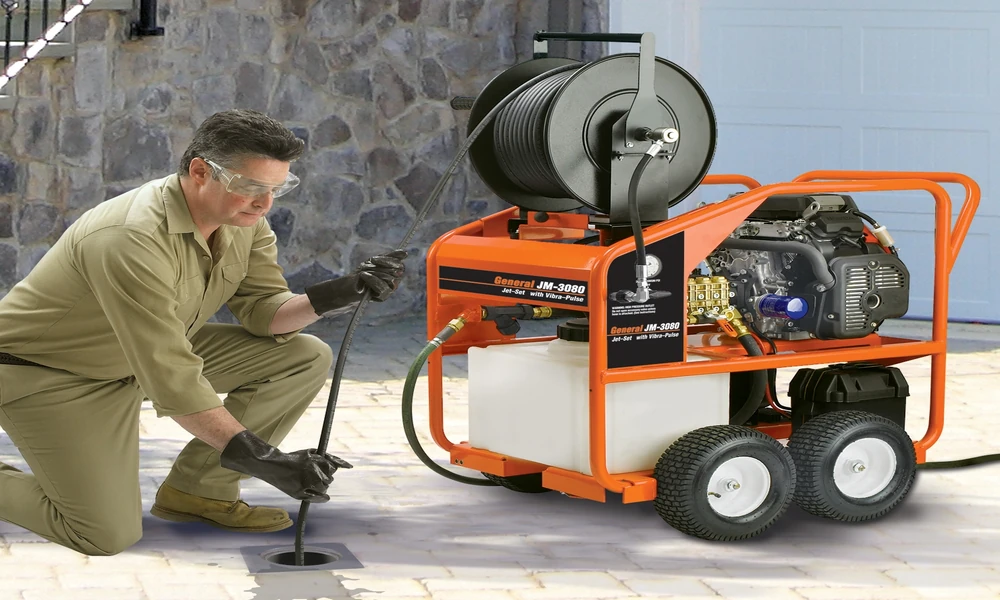
A hydro jetter sends water through a flexible hose into a nozzle with several small openings. Most of those openings face backward. Their thrust pulls the hose forward through the line while the spray scours the pipe wall all the way around. A forward-facing jet breaks up the blockage ahead. Residential jetting usually runs at a few thousand psi, which is enough to cut grease and soft roots but low enough for sound pipe. Specialized nozzles extend the range. Some spin, some are built to cut roots, and some carry chain flails for heavy scale inside cast iron.
Clogs That Favor Each Tool
Neither tool wins every time. What’s actually in the pipe should make the choice.
Kitchen grease. This is where jetting clearly wins. Fats cool and stick to the pipe in layers, and a cable often slides right through them. Hot water at high pressure strips the coating from the wall instead of just poking a hole in it.
Tree roots. A cable with a root-cutting head can chop fine roots and buy time. A jetter with a root nozzle trims them flush and flushes the pieces away. Neither one fixes the cracked joint that let the roots in.
A toy, a toothbrush or a wad of wipes in a toilet line. A snake or a toilet auger is usually the right first tool here. It can often grab the object or break it up without the cleanup that jetting brings.
Scale inside old cast iron. Decades of corrosion leave rough ridges that snag paper and waste. Chain flails and descaling nozzles smooth the interior far better than a standard cable head.
Sand, silt and sludge in a sagging line. Jetting flushes sediment out of low spots. A cable mostly churns it and leaves it in place.
Why the Camera Usually Goes in First
The most important step in any serious drain job happens before the cleaning starts. A sewer camera on a flexible push rod shows the pipe material, the clog’s location and the line’s condition. It also shows whether the pipe can safely take high-pressure water at all.
Most of the time it can. But some older properties still have Orangeburg pipe, a fiber-and-tar material that softens and deforms with age. Others have clay joints that have shifted badly out of line, or cast iron so thin that it’s mostly rust. Jetting a pipe in that condition can make an existing break worse. In those cases, the camera footage tells the homeowner that the line needs repair or replacement, not cleaning.
How a Jetting Appointment Actually Unfolds
A typical visit follows a predictable order:
- The technician finds an accessible cleanout, either inside near the foundation wall or outside in the yard.
- A camera inspection checks the pipe’s condition and pinpoints the trouble spots.
- The technician picks a nozzle and pressure suited to the pipe material and the type of buildup.
- The hose works through the line in passes, cutting the blockage and washing loosened debris down toward the sewer main.
- A final camera pass confirms the walls are clean and leaves the homeowner with a record of the line’s condition.
That last step matters more than people expect. Footage taken after cleaning shows cracks, offsets and root entry points that were hidden under the buildup. That information is what you need to plan for the future instead of reacting to the next backup.
What You Pay For and How Long It Lasts
Snaking usually costs less per visit and takes less time, so it’s sensible for a one-off clog in a branch drain. Jetting costs more because of the equipment, the inspection and the labor, but it usually lasts much longer before the line needs attention again. Homes with large mature trees near the sewer lateral, or households that cook a lot, sometimes put maintenance jetting on a schedule of every year or two. For a line that keeps backing up, that is often cheaper than paying for emergency snaking every few months.
Another cost is easy to miss. Pouring chemical drain openers into a blocked line before calling for help leaves caustic liquid in the pipe. That’s hazardous for whoever opens the cleanout, and the chemicals can attack older metal pipe. Telling the technician what you poured, or skipping the bottle altogether, makes the job safer and simpler.
Life After a Clean Line
A freshly jetted pipe can clog again quickly if the same habits continue. Grease is the biggest repeat offender. The Bucks County Water & Sewer Authority’s guidance on what stays out of the drain says most grease-related sewer blockages start in homes, not restaurants. Its advice is to let cooking fat cool in a jar or can and throw it in the trash. Wiping greasy pans with a paper towel before washing helps too, and so does keeping “flushable” wipes out of the toilet no matter what the package says.
Beyond habits, it pays to know where your cleanout is and to keep its cap accessible, because emergency calls go faster when the technician doesn’t have to dig for it. Save the camera footage from each visit as well. Comparing it from year to year shows whether a root intrusion is growing or a joint is sinking, so the next decision about that line can rest on what you’ve seen.