Your home is small, and every lift you’ve looked at so far seems to fall into one of two disappointing categories: genuinely safe and certified, but visually plain and clunky, or attractive and modern-looking, but vague about safety credentials in a way that makes you nervous. It feels like you’re being asked to choose one or the other.
This false choice is more common in marketing than in actual engineering reality, and it leaves small-home owners feeling like they’re settling no matter which direction they lean. Nobody should have to accept a visually unappealing lift purely because their home is compact, or gamble on unverified safety claims purely because a model happens to look good in photos.
The genuinely good news is that a mini lift for homes doesn’t have to force this trade-off at all. Reliable, certified engineering and attractive, modern design are entirely compatible in a well-built compact model. This guide covers how to find both.
What Makes a Compact Home Lift Genuinely Reliable
Reliability in a mini lift comes down to the same fundamentals that matter in any lift, regardless of size: independent safety certification, automatic emergency descent, and door interlock systems that prevent movement unless properly closed. None of these features become optional or diminished simply because the cabin itself is smaller.
When evaluating a compact home lift, don’t assume smaller automatically means a stripped-down safety package. Ask directly whether the same certification and safety systems found in larger models apply equally to the compact configuration you’re considering, and treat any hesitation in the answer as a genuine concern.
It’s worth remembering that the core mechanical principles behind a lift, air pressure control, sealed cylinder design, precision landing, don’t inherently change based on cabin size. A well-engineered compact model simply scales these same principles down proportionally, rather than cutting corners on the underlying engineering itself.
Small Home Lift Design: Proving Style and Size Aren’t Opposites
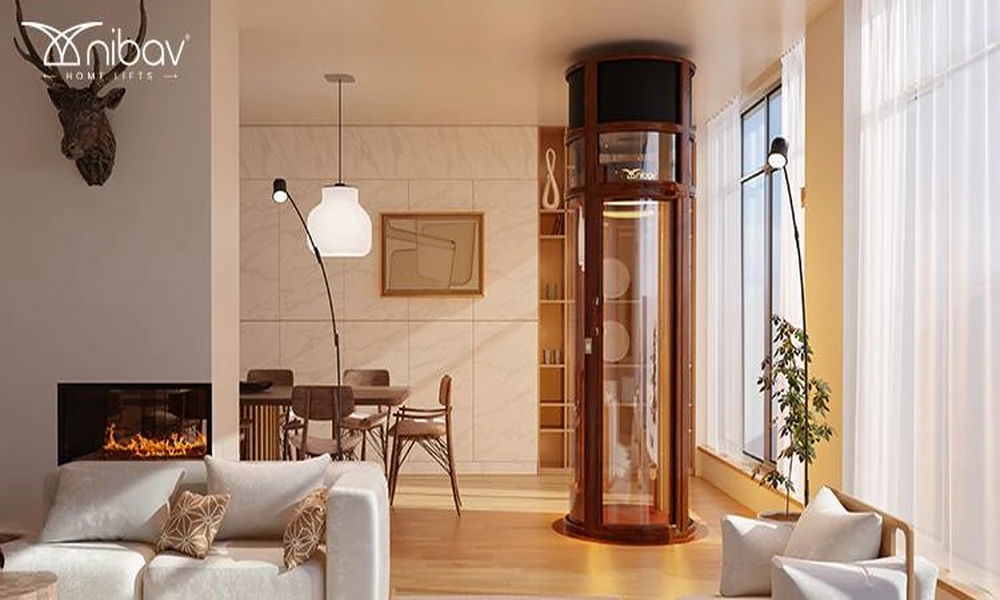
A small home lift can absolutely be visually appealing rather than purely functional. Transparent, panoramic cabin designs using reinforced polycarbonate bring light and openness into even the most compact footprint, avoiding the boxy, industrial look often associated with smaller lift categories in the past.
Finish options matter here too. A range of colours, textures, and metallic or matte finishes allow even a compact cylinder to complement your home’s existing interior design, rather than looking like an obviously budget-driven addition standing out awkwardly from its surroundings.
Mini Lift for Homes: Where Compact Sizing Genuinely Fits
A mini lift for homes typically requires a clear floor footprint of roughly one square metre, small enough to fit into a stair void, an unused corner, or even a compact utility area without demanding a dedicated room. This makes it a realistic option for terrace houses, link homes, and smaller townhouses where a larger configuration simply wouldn’t be feasible.
Understanding this genuine size advantage helps set realistic expectations. A mini lift isn’t a compromise for households who couldn’t afford something bigger, it’s often precisely the right product for a compact home’s actual layout and needs.
Small Home Lift Price: What Genuine Value Actually Looks Like
Small home lift price tends to sit at the more accessible end of the market, largely because compact dimensions require less material and simpler installation. This doesn’t mean you’re getting a lesser product, it means you’re paying appropriately for a smaller, well-matched configuration rather than overpaying for capacity your home doesn’t need or have space for.
When comparing small home lift price across suppliers, confirm that certification and core safety features remain consistent regardless of the compact sizing, rather than assuming a lower price automatically signals reduced safety standards.
Balancing Safety and Style: A Practical Checklist
Before choosing a mini lift, confirm independent safety certification first, then evaluate design options within that certified shortlist. This order matters, since starting with aesthetics alone risks falling for an attractive but unverified option, while starting with safety alone ensures every design choice you consider afterward is genuinely trustworthy.
Visit a showroom if possible to see how a compact, certified model actually looks and feels in person, since photographs don’t always capture how genuinely well-designed a small cabin can be until you’re standing in front of it.
Bring a rough idea of your home’s existing colour palette and finishes when visiting, so you can judge how well a particular cylinder finish would actually integrate with your space, rather than choosing purely based on how it looks in an isolated showroom display.
Why Nibav’s Compact Range Proves Safety and Style Aren’t a Trade-Off
Nibav’s Series III range was engineered specifically to prove that compact sizing and genuine design appeal aren’t mutually exclusive. Every model, regardless of size, is TÜV NORD certified, with automatic emergency descent, precision floor levelling, and triple-layer door lock safety standard across the entire range, not reserved for larger configurations.
With a screwless, panoramic polycarbonate cabin and over 14 colour and finish options even at the compact end of our range, Nibav’s mini lifts are built to look genuinely considered, not simply functional.
What Sets Nibav’s Mini Lifts Apart
Nibav’s Series III models install within just 1010mm of clear floor space, fitting neatly into stair voids and corners across typical Malaysian terrace and link homes, while sharing the same core certified engineering found across our entire range. With installation completed in four to five working days and local, Malaysia-based servicing, Nibav proves a genuinely small footprint doesn’t require any compromise on safety or design.
Frequently Asked Questions
Are mini lifts for homes as safe as larger models?
Yes, provided they carry the same independent certification and core safety features as larger configurations. Size alone shouldn’t determine safety standards on a genuinely well-engineered model.
Can a small home lift still look stylish?
Absolutely. Transparent panoramic cabins and a range of colour and finish options mean compact lifts can complement a home’s design just as effectively as larger models.
What size home genuinely suits a mini lift?
Terrace houses, link homes, and smaller townhouses with roughly one square metre of available floor space are typically well-suited to a mini lift configuration.
Is small home lift price lower because of reduced safety features?
Not necessarily. Lower price for compact models generally reflects less material and simpler installation, not reduced safety, provided certification remains consistent.
How do I choose between safety and design when selecting a mini lift?
Confirm certification and safety features first, then choose your preferred design and finish from within that certified shortlist, rather than prioritising appearance before safety.