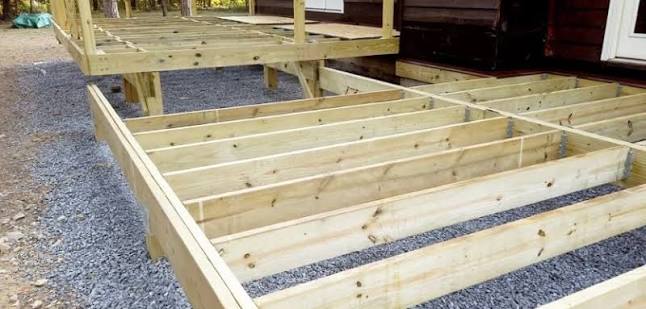
Getting the spacing right underneath a deck can make a surprising difference to how the finished surface feels. A frame that looks perfectly solid while you’re building it can feel springy once the boards are down if the joists are too far apart.
So, is decking joist spacing 600mm actually suitable? Sometimes, yes. But it isn’t a figure you should automatically use for every timber deck. The answer depends on the decking board, its thickness and grade, the expected load, and the design of the frame.
That distinction matters because 600mm centres are used in some structural timber applications, but decking boards have their own support requirements.
Why Joist Spacing Matters
Deck joists sit underneath the boards and provide the support that keeps the surface firm. If they’re too widely spaced for the boards being used, the boards have to span a greater distance between supports. That can lead to more movement underfoot and put additional stress on fixings.
A closer frame isn’t automatically better either. Adding more joists increases the amount of timber and labour required, so there is little point in using unnecessarily tight centres if the decking manufacturer allows a wider arrangement.
For many standard timber decking products, around 400mm centres is a common starting point. Some thicker boards can work at wider centres, while certain composite products have their own specific requirements. The manufacturer’s installation guidance should always be checked before the frame is built.
Is Decking Joist Spacing 600mm Suitable?
This is where things get a little more interesting.
Decking joist spacing 600mm can be suitable for particular board specifications and structural arrangements. It shouldn’t, however, be treated as a universal recommendation.
The Timber Decking and Cladding Association’s guidance includes joist arrangements from 300mm to 600mm centres for raised timber decks, with the appropriate spacing depending on the size and grade of the deck board. Its guidance also gives different span information for joists at 400mm, 500mm and 600mm centres.
The important point is that joist spacing and joist span aren’t the same thing. The spacing describes the distance between adjacent joists, while the span is the distance a joist travels between its supports. Both need to work together.
For a typical domestic deck, using a wider centre distance simply because “600mm is standard for joists” can be a mistake. The decking boards themselves need to be capable of spanning that distance.
What Changes the Correct Spacing?
Board thickness is one of the first things to check. A thicker, stronger decking board may be able to bridge a wider gap than a thinner board. The material and strength grade also matter, particularly with timber.
The direction of the boards can affect the frame too. A diagonal decking layout creates different support requirements from boards running straight across the joists, so the frame may need closer centres.
Then there is the intended use. A quiet garden deck with ordinary foot traffic isn’t necessarily designed for the same loading as a busy access route, commercial deck or area supporting heavy items.
This is why there isn’t one spacing measurement that works for every project.
Don’t Confuse Joist Spacing With Joist Size
It is easy to look at a deck frame and assume that larger joists automatically mean you can space them further apart. That’s not quite how it works.
Joist size affects how far each joist can span between beams or other supports. Joist spacing affects how much support the decking boards receive.
For example, TDCA guidance provides span information for 150 x 50mm nominal joists at different centres and shows that the maximum effective span changes as the spacing changes.
The timber grade matters as well. C16 is commonly used for domestic decking, while higher grades such as C24 may be specified for longer spans, smaller sections or more demanding applications.
So don’t choose joist size and spacing independently. They are two parts of the same structural design.
What About 400mm Centres?
For many standard decking boards, 400mm centres are a practical choice. They provide more frequent support without requiring an excessive number of joists.
Some current UK decking guidance gives 400mm as a common arrangement for standard 28mm timber boards, while thicker boards may allow wider spacing when supported by the relevant product guidance.
There is also a practical advantage. A closer frame can make the finished deck feel firmer, particularly in areas that receive regular foot traffic.
If you’re unsure about using decking joist spacing 600mm, checking the board specification first is usually more useful than simply looking at the frame timber.
Don’t Apply Rules From Another Trade
Construction work often involves several trades, and each has its own rules and safety considerations. A figure that is perfectly normal in one type of work doesn’t automatically transfer to another.
Take gas bonding, for example. Protective bonding has a specific purpose within an electrical installation, and requirements depend on factors such as whether metallic pipework is an extraneous-conductive-part and where it enters the building.
That’s a useful reminder for decking too. Don’t assume that a spacing you’ve seen used for floor joists, another type of timber structure, or a previous project will automatically suit your decking boards.
Good trade work starts with the specification for the job in front of you.
Check the Frame Before Laying the Boards
Once the spacing has been decided, don’t rush straight into fixing the boards.
Check that the joists are properly supported, level and securely fixed. Look at the overall frame rather than checking individual joists in isolation. Noggins or blocking may be needed in suitable locations to stiffen the structure.
The timber itself matters too. TDCA recommends pressure-treated Use Class 4 timber for deck joists and other exterior structural support members.
If the deck is attached to a property, pay particular attention to the wall plate, drainage and the damp proof course. TDCA guidance recommends maintaining a gap between the wall plate and building so water can drain freely and says the DPC should not be compromised.
So, Should You Use 600mm Centres?
There isn’t a simple yes or no.
Decking joist spacing 600mm can be appropriate where the decking board, joist size, structural arrangement and expected loading all support that spacing. But for many commonly used decking boards, closer centres are more appropriate.
The safest approach is to work from the decking manufacturer’s specifications rather than choosing a spacing first and trying to make the rest of the frame fit around it.
A good deck starts underneath the boards. Get the support structure right, and the finished surface will have a much better chance of staying firm, stable and durable for years to come. Follow TradeFox App for more details.